AI Receptionist vs Answering Service | Local Business Call Handling
AI Receptionist vs. Answering Service: What Local Businesses Need to Know
Introduction
Local businesses are missing more calls than they realize.
Not because they don’t care — but because the way people expect businesses to respond has changed.
For service-based businesses in Tyler and across East Texas, missed calls often happen during the busiest parts of the day: on job sites, in transit, or while serving customers.
While this challenge exists everywhere, local and regional service markets tend to feel the impact first. When a call goes unanswered, customers rarely wait.
This has led many business owners to look for help handling inbound calls. The two most common options are traditional answering services and AI receptionists.
Although they sound similar, they serve very different roles.
What Is an Answering Service?
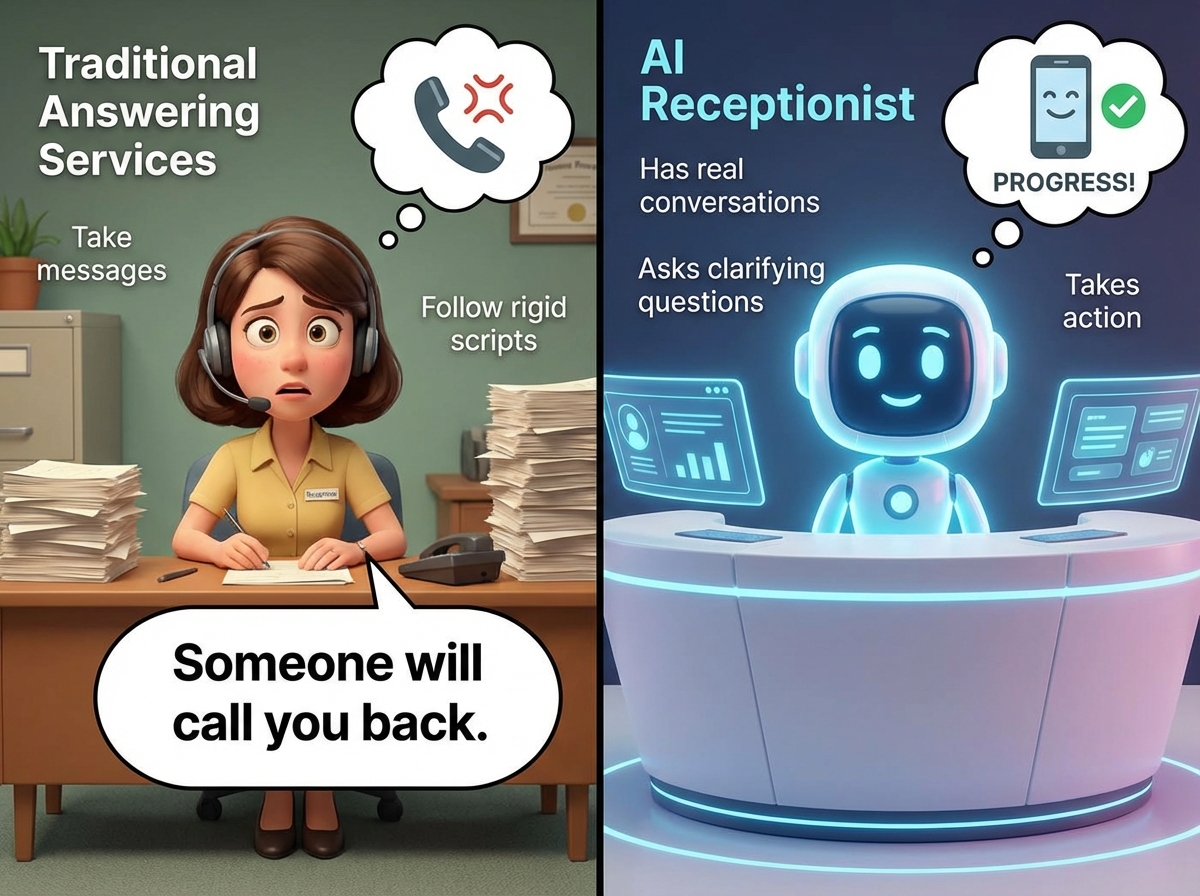
A traditional answering service is a human-operated call center that answers calls on behalf of a business.
In most cases, an answering service will:
Answer calls during specific hours
Use a scripted greeting
Take messages
Forward information to the business owner or staff
The primary purpose is coverage, not resolution.
Answering services are effective for basic message taking and after-hours support, but they rely heavily on callbacks and follow-up.
What Is an AI Receptionist?
An AI receptionist is a software-based system that answers calls automatically and interacts with callers in real time.
Instead of simply recording information, an AI receptionist can:
Understand why someone is calling
Ask clarifying questions
Provide immediate answers
Schedule appointments
Route urgent calls
Capture lead details automatically
The goal is to keep the conversation moving forward, even when no one is available to answer the phone.
Key Differences Between an AI Receptionist and an Answering Service
Conversation vs. Message Taking
An answering service focuses on collecting information.
An AI receptionist focuses on interaction.
Rather than ending the call with “someone will call you back,” an AI receptionist helps the caller take a next step during the call itself.
Speed and Availability
Answering services operate within staffing limits and scheduled hours.
AI receptionists are available 24/7 and respond instantly.
For service businesses, especially those operating locally, response time often matters more than polish.
Action During the Call
Answering services pass information along for later follow-up.
AI receptionists can take action immediately, such as scheduling appointments or routing urgent calls.
This reduces reliance on callbacks, which many customers no longer wait for.
Consistency
Human answering services can vary based on the agent, shift, or workload.
An AI receptionist delivers consistent responses every time, based on predefined rules aligned with the business.
Why This Difference Matters for Local Businesses
Most service-based businesses do not lose customers because of poor service.
They lose customers because of timing.
In local and regional markets like Tyler and surrounding East Texas communities, customers often call multiple businesses quickly. The first clear response frequently wins.
These same dynamics apply nationally, but they are often more noticeable in local service markets where response speed directly affects who gets the job.
When an Answering Service Still Makes Sense
An answering service may be a reasonable option when:
Only basic message taking is needed
Call volume is low
No scheduling or routing is required
Manual follow-up is acceptable
For some businesses, this level of support is sufficient.
When an AI Receptionist Is the Better Fit
An AI receptionist is often a better fit when:
Calls are time-sensitive
Appointments need to be booked quickly
Customers expect immediate answers
Missed calls regularly lead to missed opportunities
This is common across many service industries, including trades, appointment-driven services, and customer-facing local businesses.
The Bigger Shift Businesses Should Understand
This comparison is not about technology replacing people.
It reflects a shift in customer behavior.
People now expect acknowledgment immediately, even if the full solution comes later.
AI receptionists exist to bridge that gap.
Final Takeaway
Answering services and AI receptionists serve different purposes.
One records information.
The other keeps the conversation moving.
Whether a business operates in East Texas or serves customers elsewhere, the core question is the same: how quickly does the business respond when someone reaches out?
Understanding this difference helps ensure missed calls do not quietly become missed opportunities.
More information here: https://theothersba.com/ai-receptionist
